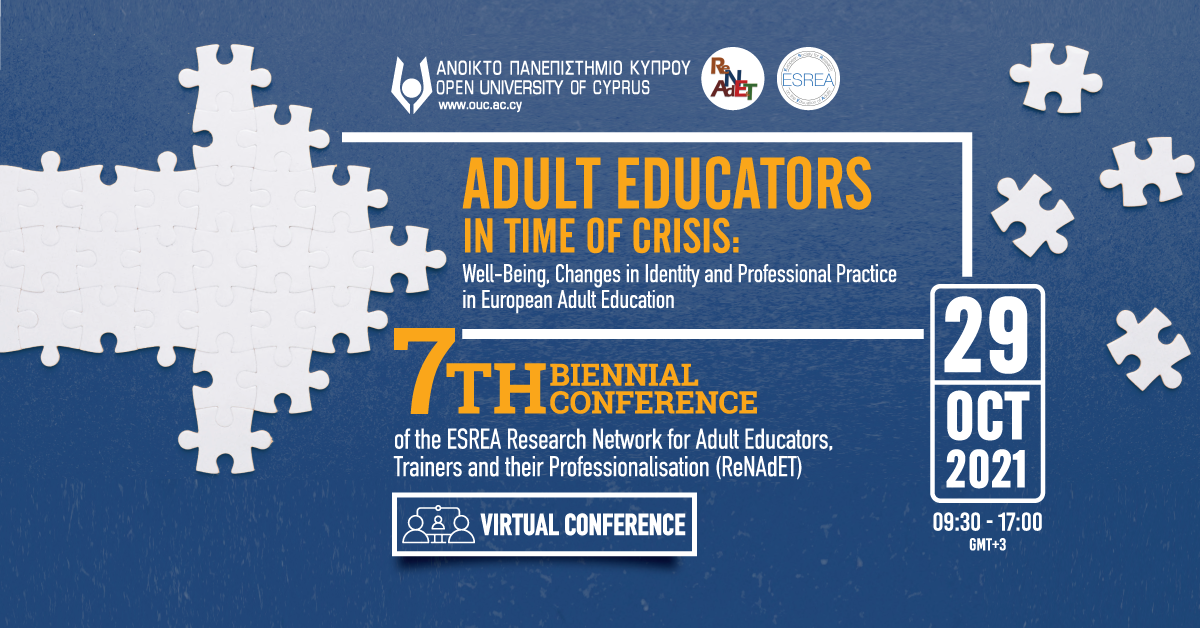
This year’s one-day extraordinary meeting that is organised with the support and collaboration of the Open University of Cyprus (OUC), suggests an emphasis on the impact of crisis on adult educators’ practices, roles, and well-being. Any type of crisis –be it natural disaster, health pandemic, social, political or economic disruption– is exacerbating pre-existing education disparities by reducing the opportunities for many of the most vulnerable adults (i.e. those living in poor or rural areas, girls, refugees, persons with disabilities and forcibly displaced persons) to continue their learning, affecting at the same time the roles and practices of the professionals involved. It is now more than obvious that COVID-19 caused a global crisis that has rendered social inequalities –related, but not limited, to disability, employment status, immigration status, income, language, race, and social-class–more visible and piercing.
More specifically, the current COVID-19 crisis has resulted in unparalleled changes of teaching and learning practices in our field (new learning modalities, significant increase in online teaching), as well as in social and professional life and well-being for those immediately involved (work status, lack of direct face-to-face interaction with learners, revision of existing roles and practices). Much of the training that had started as face-to-face in classroom environments is now being pursued online. Furthermore, individuals are being encouraged to use the time freed up by short-time work schemes to take up new training. From the onset of the pandemic, adult education and training professionals were immediately tasked with implementing distance learning modalities, often without sufficient guidance, training, or resources. In many contexts, professional development has moved online or been disseminated via telephone and video applications.Web-based class meetings and messaging applications have become useful tools and new ways of communicating with learners and the education community, but some marginalized adult educators and learners may have missed out on such support. As such, the current COVID-19 crisis provides a powerful test of the potential of adult education professionals. It also highlights the key limitations in our field, including for example the prerequisite of adequate digital skills, computer equipment and internet access to undertake training online, the difficulty of delivering traditional work-based learning online, and the struggle of teachers used to classroom instruction. Among numerous concerns, the social and economic vulnerability of many adult learners has been dramatically foregrounded, highlighting the social inequalities that continue to characterize much of our field. As many services close and social distancing practices continue, difficult-to-reach and underserved populations face further obstacles to adult education. In response, our own engagement with teaching has largely shifted online in the last year. This situation yields risks as well as opportunities for our profession. We live in a society with a pernicious digital divide, and while technology might be a suitable way to facilitate adults’ learning in some circumstances, not everyone has reliable access to an Internet connection nor the digital literacy skills to engage in self-directed learning in a virtual environment. eLearning can further serve to disadvantage the most vulnerable groups in society. The current situation has also been challenging for many of us who have research and service responsibilities in addition to teaching. Although some can work from a home office, access to critical resources and competing personal and family responsibilities may considerably affect productivity. Many of our colleagues may not feel well-prepared for digital education, and institutions and workplaces might have to engage with online modes of working and telecommuting more than they are accustomed to. It will be important to capture and learn from these experiences. They may offer prospects for research. It will also be fascinating to see how far learning and work shifts toward online and distance modalities once the world begins to recover from COVID-19. Some of the questions to be addressed in the 7th meeting of ReNAdET are the following:
A limited number of papers (max. 20) will be presented. Interested contributors may choose –but are not limited to– from the following shortlist of sub-themes:
|
Important Dates1st July 2021 (extended)
Deadline for submission of paper proposals 1st July 2021 Registration begins (free of charge for all participants) 29th August 2021 Acceptance of paper proposals will be announced 26th October 2021 Final deadline for registration (free of charge for all participants) 30th November 2021 Deadline for submission of the final paper (5000 words max.) 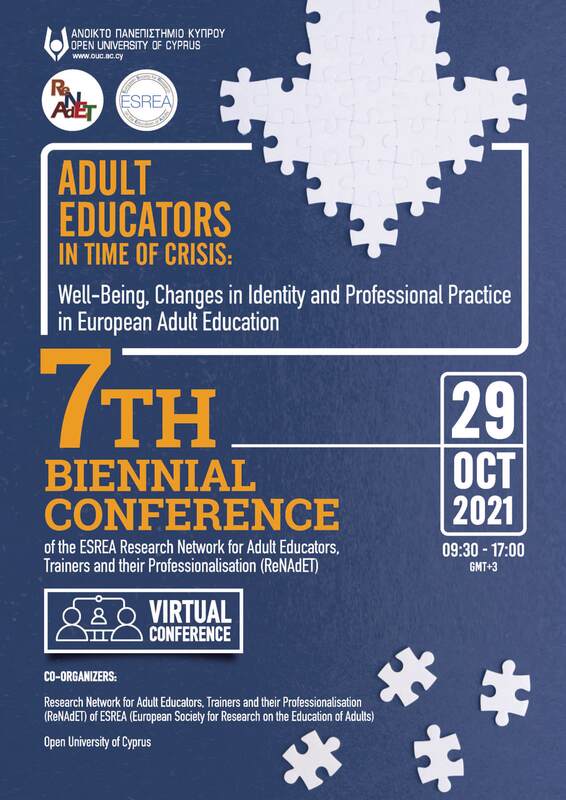
|
Search by typing & pressing enter
